Spanish Scientists conducted a review and their scientific findings were recently released in a pub med paper. They found there are nine predominant hallmarks of aging.
Of significant relevance, is this scientific research shows almost all the hallmarks of aging have an association at the cellular level.
Aging research has experienced an unprecedented advance over recent years, particularly with the discovery that the rate of aging is controlled, at least to some extent by genetic pathways and biochemical processes conserved in evolution.
The Review enumerates nine tentative hallmarks that represent common denominators of aging in different organisms, with special emphasis on mammalian aging. Aging is characterized by a progressive loss of physiological integrity, leading to impaired function and increased vulnerability to death.
Here are the nine hallmarks of aging, accompanied by explanation notes:
1) Genomic Instability
Genomic instability refers to the high frequency of mutations within the genome of a cellular lineage. As DNA changes occur, failures accumulate and the DNA becomes less likely to fix itself.
2) Telomere Attrition
Telomeres are the terminal caps of chromosomes that become shorter as individuals age. The leading hypothesis is that telomere attrition is due to inflammation, exposure to infectious agents, and other types of oxidative stress, which damage telomeres and impair their repair mechanisms.
3) Epigenetic Alterations
The term epigenetics refers to heritable changes in gene expression that does not involve changes to the underlying DNA sequence; a change in phenotype without a change in genotype.
In additional to heritable changes, epigenetic change is influenced by several factors including age, the environment/lifestyle, and disease state.
4) Loss of Proteostasis
Proteostasis relates to folding, trafficking and degradation of proteins present within and outside the cell. Changes and accumulation of misfolded proteins is a factor in the aging process and is responsible for the onset of certain diseases (i.e. Alzheimer’s, Parkinson’s, Huntington’s and ALS diseases). As many of the diseases associated with protein aggregation increase in frequency with age, it seems cells lose the ability to clear misfolded proteins and they then aggregate over time.
Small molecule agents have been shown to reduce protein aggregation. In cell culture systems, resveratrol supplementation produced beneficial results against the accumulation of the amyloid-beta peptide, a main culprit in Alzheimer’s disease.
5) Deregulated Nutrient Sensing
Nutrient sensing is a cell’s ability to recognize and respond to fuel substrates such as glucose.
The level and type of fuel that is available to a cell will determine the type of enzymes it needs to express from its genome for utilization. Nutrients are a key regulator of tissue growth. As we age, the body becomes less efficient at absorbing certain nutrients and it automatically takes less nutrients to repair itself.
This is why exercise and consuming the right foods at regular intervals is essential. To do this give your body the right nutrients by eating organic, natural foods, ensure you stay hydrated and take quality health supplements.
Although scientific evidence shows calorie restriction can increase lifespan, it also shows that calorie restriction for long periods of time is harmful.
6) Mitochondrial Dysfunction
Mitochondrial is the enzyme that stimulates the cell to produce more energy and grow, which then increases the metabolic rate. Cells require a lot of energy in order to function correctly.
In 2003, Doctors Baur and Sinclair at the Harvard University discovered resveratrol and found it improved mitochondrial function and protected against metabolic disease. They also found resveratrol increased the lifespan of organisms and animal species by 20-40%. In 2009, Christopher Paul Erdman found that resveratrol enriched mesenchymal stem cells that are traditionally adult stem cells found in the bone marrow. Be sure to take liquid resveratrol via intraoral spray delivery as it is proven to be the most effective route of absorption for humans (250 times more effective in an intraoral spray delivery as this overcomes the “first past effect” that is associated with pills and capsules).
7) Cellular Senescence
Cellular senescence is the phenomenon when healthy cells lose their ability to divide or replicate. They reach what is known as the hayflick limit. Adult stem cells are the master cells of the body (that are with us from the day we are born). They are responsible for cellular rejuvenation, tissue and muscle repair and regeneration, and immune response throughout our lifetime. As long as the adult stem cells remain activated and keep dividing they maintain their ability of self-renewal and they continue to keep repairing. However, as we age, the ability of one’s own adult stem cells to divide and self-renew is naturally programmed to occur more slowly, their release rates reduce and they also decrease in number. Our adult stem cells therefore begin to lose their ability to repair tissues and our immune system becomes compromised, making us more susceptible to illness and disease.
8) Stem Cell Exhaustion
There are consequences associated with the decrease and exhaustion of hematopoietic stem cells (HSCs), mesenchymal stem cells (MSCs), satellite cells, and intestinal epithelial stem cells (IESCs). Altered intercellular communication occurs and this is associated with aging.
Dr Burton Feinerman reported in 2009 in the Ethiopian Review, Health News Digest that approaches to treat stem cell aging in organs include (A) stimulate existing stem cells to increase in numbers (B) administer specific lines of stem cells to repair damaged tissue and introduce young healthy cells to the organ. These approaches are now available through stem cell replacement treatments and stem cell supplements.
9) Altered Intercellular Communication
Intercellular communication relates to the manner in which cells communicate with one another. Cell signaling is part of a complex system of communication that governs basic cellular activities and coordinates cell actions. Cell signaling errors are linked to degenerative and autoimmune diseases.
The four most common ways in which human cells communicate are:
- Cell to Cell Contact
- Proteins
- Hormones
- Electrical and Chemical Signals. Electrical and chemical signals are responsible for communicating extremely complex messages between neurons or between neurons and muscles cells.
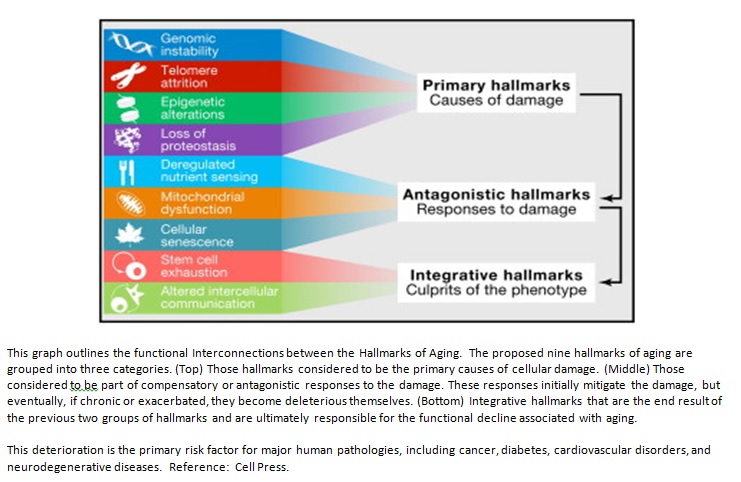

This graph illustrates the nine hallmarks of aging as described in this Review. Reference: Cell Press.
To view this document in a printable format click here. Hallmarks of Aging – Why Cell Health Is Everything.
References:
http://en.wikipedia.org
http://neuroscience.jhu.edu/rosss10-s17.pdf
http://www.glycotrainer.com/intercellular-communication/
http://www.ncbi.nlm.nih.gov/pubmed/23746838
http://www.sciencedirect.com/science/article/pii/S0092867413006454
http://www.whatisepigenetics.com/fundamentals/
Copyright ©2013 Stem Cell Worx. All Rights Reserved. For Further Information on Cell Health visit: www.stemcellworx.com